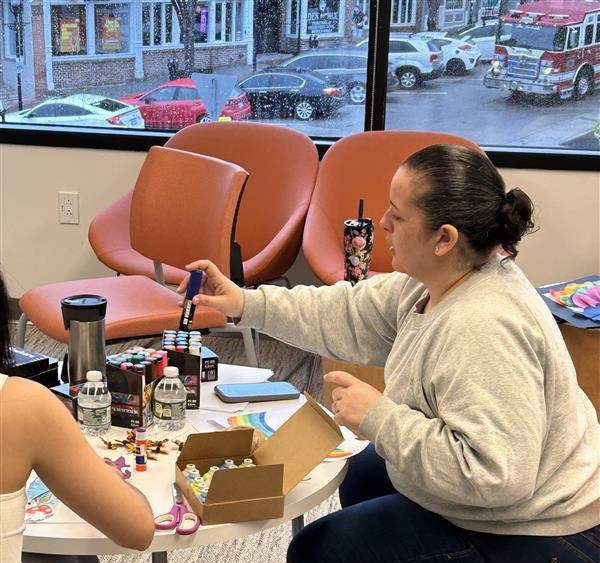
No skills required. No experience necessary.
This is what Paola Rodriguez, a certified art therapist at the Open Door Care Network, a federally-qualified health center, frequently reminds the adults who sit in her pop-up classes at Neighbors Link’s sites in Mount Kisco or Ossining, or tune in remotely from home.
Rather, it’s a chance for the participants to express feelings and emotions of anxiety or stress, often a result of trauma, that may not be easily expressed any other way.
In a sense, they let their artwork do the talking for them.
Recently, a unique exhibit at Open Door Care Network’s Ossining office (2 Church Street) displayed the work of these artists, offering a window into their personal journeys, struggles and triumphs, and celebrating their resilience. Displayed were a range of mixed media art work – composed of paint, clay, wood, felt, beads, hot glue and so on – all inspired by the artists’ personal experiences.
As defined by the American Art Therapy Association, “Art therapy is a mental health profession that enriches the lives of individuals, families, and communities through active art-making, creative process, applied psychological theory, and human experience within a psychotherapeutic relationship. Art therapy is particularly effective during times of crisis, changes in circumstance, trauma, and grief…[it] helps people feel more in control of their own lives, and helps relieve anxiety and depression.”
While many of the participants in her classes are referred by word-of-mouth, and some through behavioral health providers, no diagnosis is necessary to attend Rodriguez’s twice-a-month classes at each site or by Zoom. As a result of the open group format, some of the participants are new, while others have worked with her for several years.
“Art therapy taps into what we can’t express,” she says. “We offer them a safe space to explore feelings or thoughts they may not even know they have. People say they can’t draw, but if they can write their name, they can do it. It gives them a chance to talk to themselves.”
They work in paints, pencils, watercolors, markers, or “anything they can get their hands on.” This can include items from nature or even their own trash.
Rodriguez has them explain what they’ve created, asking them questions and encouraging group discussions that may get them to open up in ways they never expected. “It can be very personal. You may notice repeated patterns or objects. In one of the directives, I had a person who drew windows that highlighted the view of rocks and the sun. When we started to discuss this, she started crying while explaining it represented all the hurdles she had to overcome to still be here.”
She begins one class by writing a prompt on a white board – at times she may ask for a family portrait or a nature scene, but today she asks her pupils, all whom are immigrants, to “create a still shot of one of the initial things you saw when you came here.” She gives them up to an hour to create their work. One man simply includes a piece of black felt pasted to the paper. When asked, he explains, “I came to the country at night and was in pitched darkness and had no idea where I was.”
Rodriguez, who laughs that sometimes as an art therapist she feels “like an electrician or plumber” carrying her art supplies with her to any space available that day, says that art has been a constant throughout her life and that she first saw the power of art therapy when she was 7. “My grandmother at 50 had a stroke, and during her recovery we spent a lot of time drawing and cross stitching to rebuild her mobility and her skills.”
It’s always the story behind the work, she emphasizes, that tells the story, not necessarily the modality, the colors, or even the images produced. “It doesn’t have to be an aesthetically beautiful thing. It’s about whatever feels right and expresses what you’re thinking. People are often surprised by what they draw, because until they start sharing, they may not even know why they drew it.”